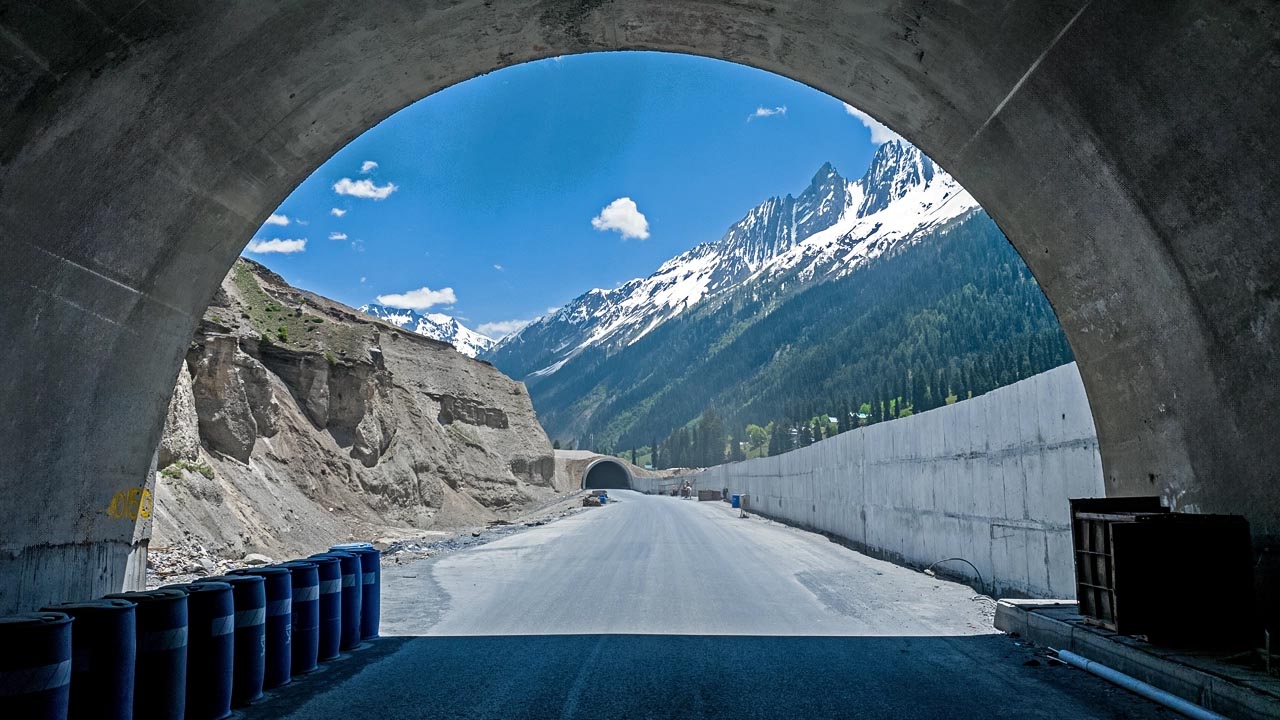
Zojila Road Tunnel Project, Jammu & Kashmir
World’s longest single‑tube bi‑directional road tunnel at the highest altitude.
The 13.153 km Zojila Tunnel, the world’s longest single‑tube bi‑directional road tunnel at the highest altitude.
Located in the Zojila region between Baltal and Meenamarg in the Union Territories of Jammu & Kashmir and Ladakh, the project is being executed to provide all‑weather connectivity across one of India’s most challenging Himalayan corridors, which remains cut off for long periods every year due to heavy snowfall, avalanches, and extreme weather conditions. Positioned at an elevation of about 11,578 feet above sea level, the tunnel represents one of the most significant engineering achievements in India’s mountain infrastructure sector.
The main tunnel begins at the West Portal at Baltal and ends at the East Portal at Meenamarg, with tunnelling carried out from both ends. The achievement of the final breakthrough marks the defining construction milestone of the excavation phase and reflects the successful completion of the most critical stage of underground works in highly demanding terrain.
The Zojila Tunnel is being constructed using the New Austrian Tunnelling Method (NATM), a method particularly suited to fragile Himalayan geology and variable rock conditions. NATM relies on sequential excavation, immediate support measures such as shotcrete and rock bolting, and continuous geotechnical monitoring, allowing engineers to respond flexibly to changing ground conditions during tunnelling. This approach has been critical to maintaining stability, safety, and construction progress in one of the most demanding underground environments in India.
In addition to the main tunnel, the project scope includes connecting highway works, bridges, protective structures, cut‑and‑cover sections, snow protection components, and the Nilgrar twin tunnels, making it a comprehensive corridor development.
Once fully operational, the project will ensure 365‑day connectivity between Srinagar and Ladakh, improving access to Dras, Kargil, Leh, and surrounding regions while significantly strengthening mobility, logistics reliability, and strategic access in a sensitive border zone.
The Zojila Tunnel Project carries immense socio‑economic and strategic importance. It is expected to transform regional connectivity, improve the movement of people and goods, reduce weather‑related isolation, and support economic activity, tourism, and essential services across the region.
At the national level, the tunnel also strengthens operational mobility and logistics preparedness in a strategically important frontier corridor, underlining its role not only as an infrastructure project but also as a national connectivity and security asset.
The execution of the project in the western Himalayas has involved exceptional engineering challenges, including fragile geology, sensitive rock formations, avalanche‑prone terrain, harsh winter conditions. Despite these difficulties, the project stands out as a transformative intervention in Himalayan transport infrastructure and a strong example of India’s growing capability in complex high‑altitude tunnel engineering.
Milestones and Achievements
• The project began on 1 October 2020, and the first blasting at the Nilgrar Tunnel was performed on 14 October 2020.
• Part one of the project was completed on 15 March 2025, covering approach roads, bridges, Nilgrar twin tunnels, cut‑and‑cover works, and snow gallery components.
• Overall safety achievement: 10 million safe man‑hours.
Project Data
• Total project length, including tunnel roads and bridges: 30.894 km.
• Main tunnel length: 13.153 km.
• Nilgrar Tunnel T1 length: 457.35 metres.
• Nilgrar Tunnel T2 length: 1,953.63 metres.
• Bridges: 3 bridges with a total length of 460 metres.
• Shaft‑1 (West): 474.30 metres.
• Shaft‑2 (Central): 367.38 metres.
• Shaft‑3 (East): 213.50 metres.